In this Blog Post:
Managing money is one of the most critical—and often most stressful—parts of running a small business. Between budgeting, invoicing, tax prep, and expense tracking, it can feel like a full-time job. But AI is making financial management easier, faster, and smarter—without the need for an accounting degree. Here’s how small business owners can use AI to take control of their finances in 2025.
1. ChatGPT for Budgeting, Forecasting, and Expense Planning
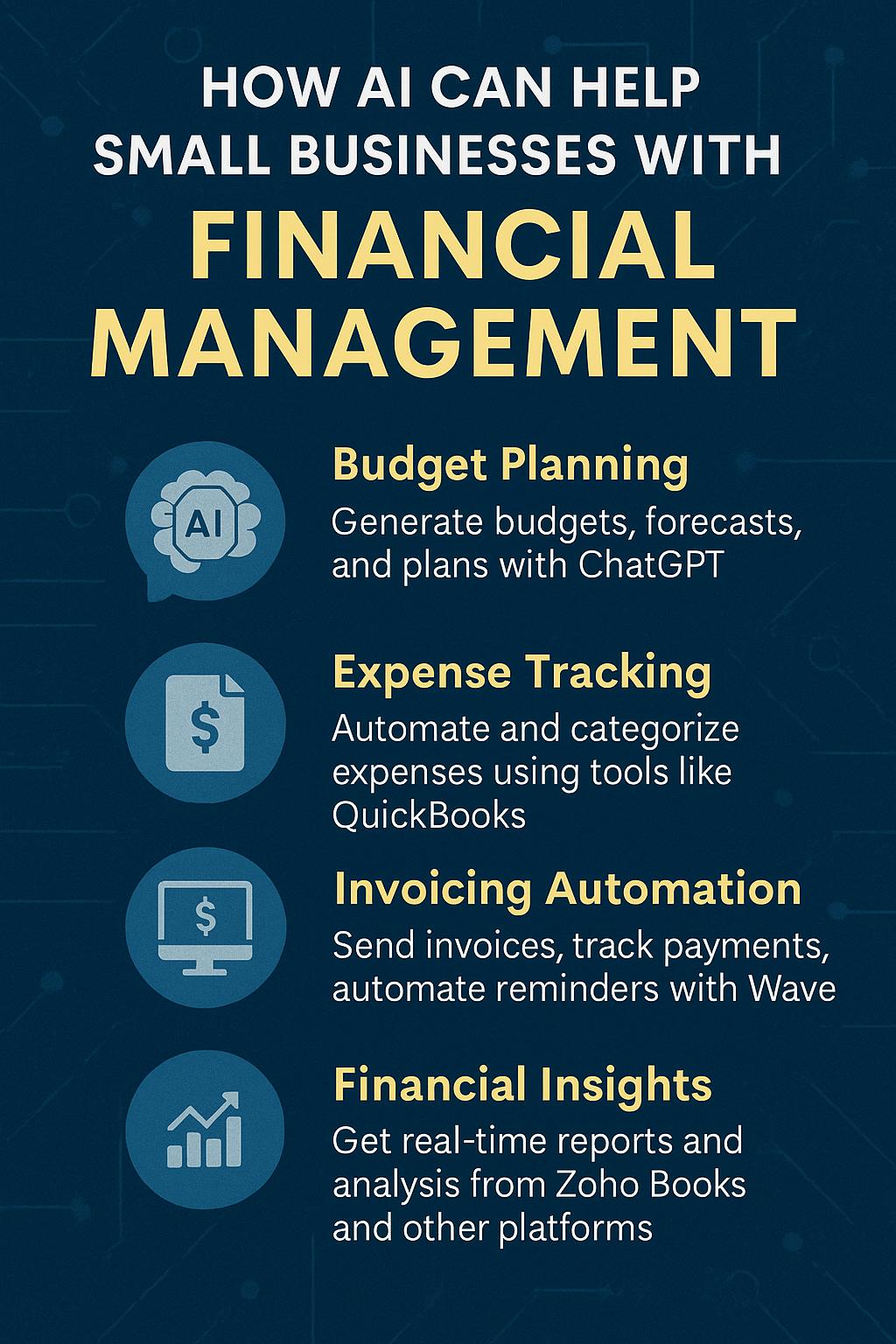
ChatGPT is more than a writing assistant—it can help you build simple budgets, forecast income, and break down financial scenarios. You can prompt it with your past revenue, monthly expenses, and growth plans, and it can suggest how to allocate your budget. It’s also great for helping you understand complex financial concepts in plain English.
2. QuickBooks with AI-Powered Automation
QuickBooks uses AI to help automate accounting tasks. From categorizing transactions to generating profit-and-loss reports, it saves hours of manual work. The AI can also flag unusual activity, predict cash flow shortages, and offer financial insights based on your history.
3. Wave: Free Accounting Software with Smart Features
Wave is a favorite among solopreneurs and freelancers because it offers powerful financial tools for free. Its AI features include automatic bank imports, receipt scanning, and invoice tracking. It’s ideal for small business owners just starting out who want automation without monthly fees.
4. Zoho Books: End-to-End AI Accounting
Zoho Books includes AI-driven automation for everything from billing and expense tracking to project-based accounting. It even uses machine learning to recommend tax-saving moves and highlight financial trends. If you already use Zoho CRM or Zoho One, this tool integrates seamlessly.
5. Melio: Smart Bill Payments and Vendor Management
Melio helps you schedule and send payments to vendors using credit cards—even if they only accept bank transfers. Its AI tracks due dates, syncs with your accounting tools, and optimizes your cash flow strategy. It’s perfect for small shops and service providers juggling multiple suppliers.
6. AI for Invoicing and Payment Reminders
Late payments can hurt your cash flow. AI tools like FreshBooks, Xero, and Zoho Invoice can automate invoice creation and send smart reminders based on client behavior. They can even personalize reminder emails to improve payment response rates.
7. Predictive Analytics for Smarter Decisions
Advanced platforms like Fathom and LivePlan use AI-powered analytics to model different financial outcomes. You can compare what-if scenarios like raising prices, cutting expenses, or hiring new staff—so you’re always making informed decisions.
Tips to Get Started with AI Financial Tools
- Start small: Use ChatGPT to experiment with budgets or summarize monthly reports.
- Pick one tool: Choose QuickBooks, Wave, or Zoho Books to handle your core accounting.
- Automate invoices: Set up recurring billing and reminders with FreshBooks or Xero.
- Review AI insights monthly: Let AI point out trends and red flags to act on.
Final Thoughts
AI is turning financial management from a headache into a strategic advantage. With tools that automate, predict, and organize, small business owners can focus less on spreadsheets—and more on scaling. Whether you’re just starting or ready to grow, AI is your new CFO.
Looking for more AI tools to power your business? Read our full guide: How AI is Empowering Small Businesses in 2025.